Learning English takes time, but it does not have to feel slow. Many learners know grammar rules, yet they freeze when they need to speak, or they forget new words a few days later. Artificial intelligence, or AI, can help because it gives you a patient practice partner, ready at any time. You can ask questions, try sentences, make mistakes, and try again, without feeling shy in front of a class.
AI will not learn English for you. It can make practice easier, more regular, and more personal. This guide shows simple ways to use AI for speaking, writing, vocabulary, listening, and reading — no expensive course needed.
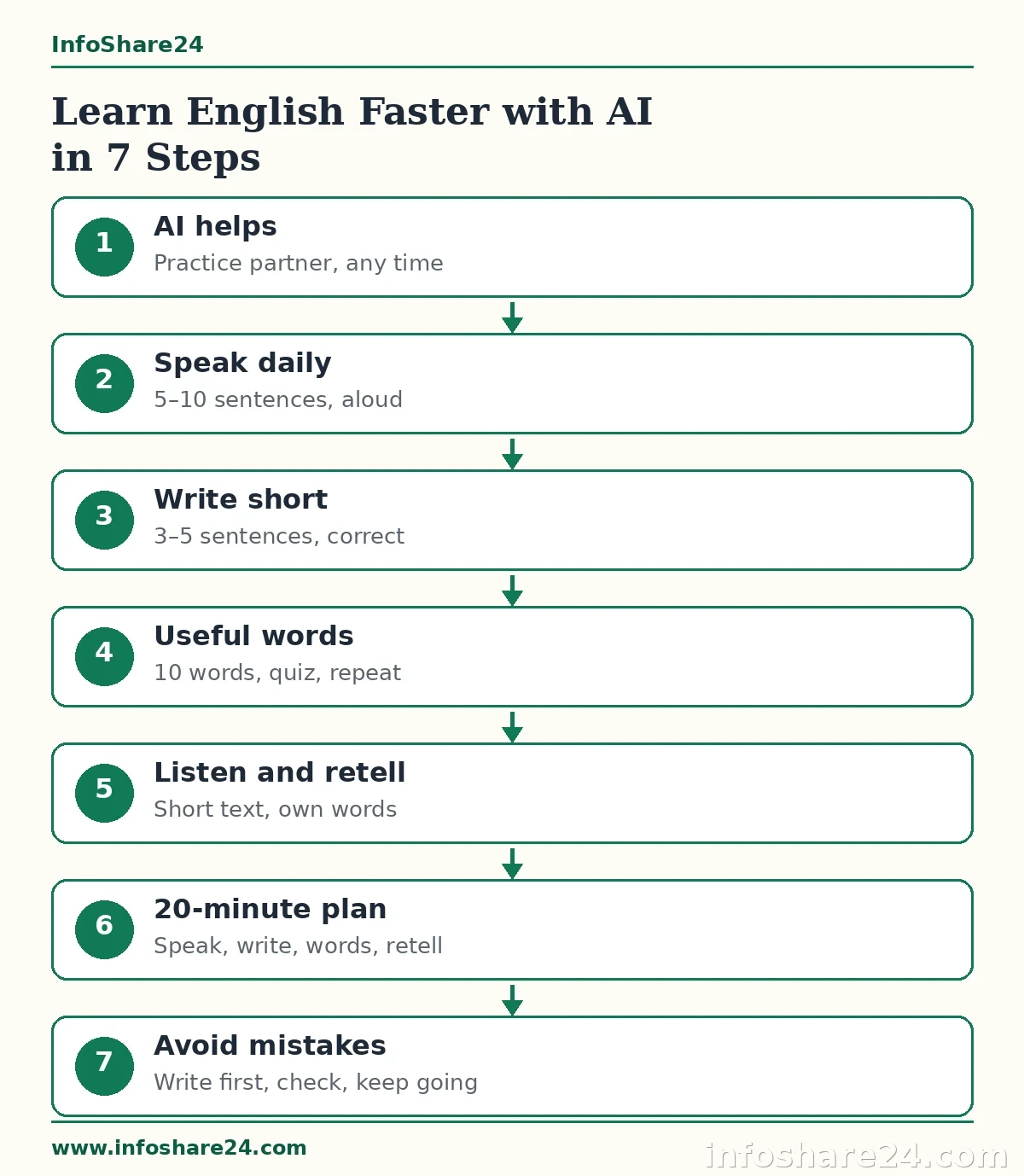
Why AI Can Help You Learn Faster
- Most people learn slowly not because they lack talent, but because they lack regular, useful practice. A textbook can explain a rule, but it cannot listen to your answer or tell you why a sentence sounds strange. An AI chatbot can do that in seconds, as many times as you need.
- AI can also match your level. Ask it to use easy words and short sentences. If a word is too hard, ask for a simpler example. If a sentence is too easy, ask for a slightly harder one. This keeps learning comfortable, not boring and not overwhelming.
- Private practice also builds confidence for real conversations. Still, AI can make mistakes, so check important sentences.
Speak English Every Day with AI

- Speaking is often the hardest skill, because you cannot pause a real conversation to check a dictionary. AI practice helps you build the habit first. Start with a short daily chat on a simple topic you know, such as your routine or weekend plans. Ask the AI to use simple English, and try five to ten sentences. Short answers are fine.
- Try these prompts: “Talk with me in simple English about my daily routine. Correct my mistakes in a kind, short way.” and “Ask me one easy question at a time about my hobbies, and wait for my answer.”
- If you use voice input, read your answer aloud before sending it. When corrected, say the correct sentence aloud twice, then use the same pattern in a new sentence, such as “I am interested in cooking” after learning “I am interested in music.”
Write Short Sentences and Get Simple Corrections

- Writing with AI works best when you start small. Writing a long paragraph often brings a long list of corrections that feels hard to follow. Instead, write three to five short sentences about one topic, then ask for simple help. For example, write about yesterday — what you did and enjoyed — then ask the AI to correct only the grammar and explain each change briefly.
- Follow these habits: write first, then ask for help; ask for one problem at a time; keep a small notebook for corrections you see again and again; rewrite the corrected version yourself.
- Also compare friendly and formal English: ask for both versions of a message and notice which words change. If a correction uses words you do not know, ask for a simpler version.
Learn Words That You Will Actually Use
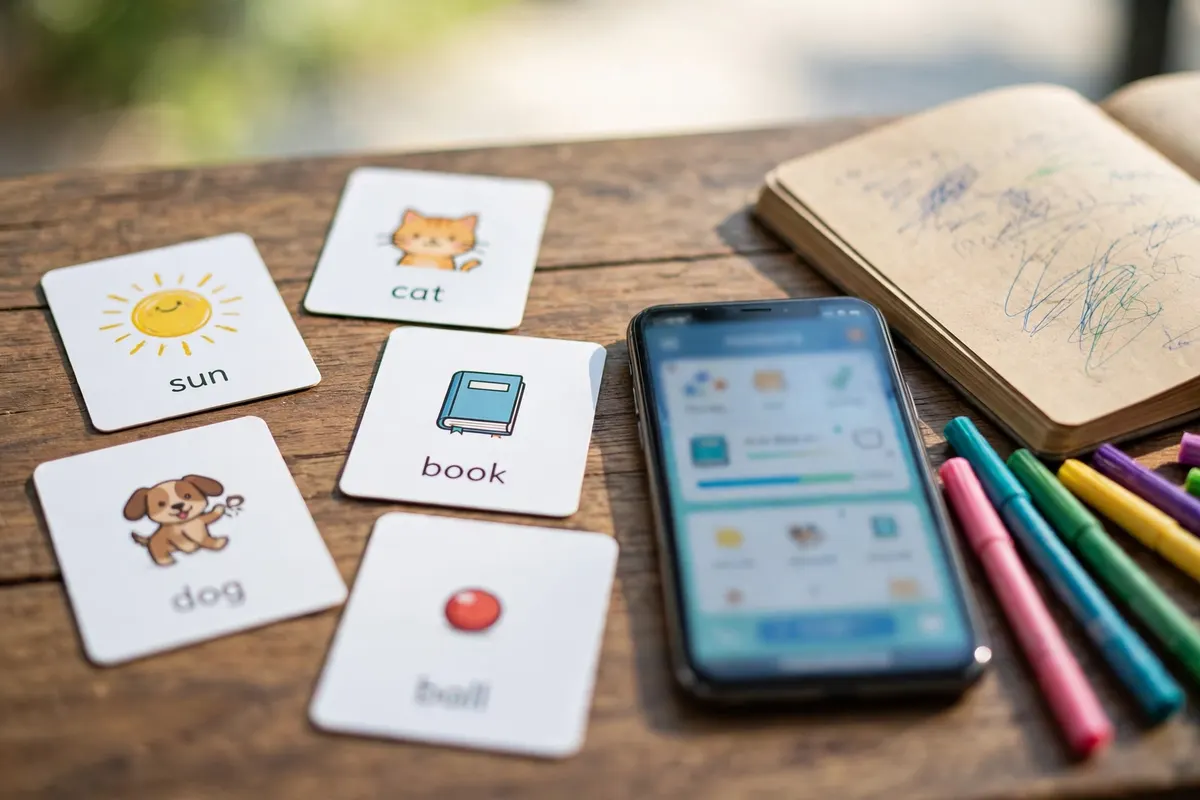
- Many learners collect long lists of difficult words, then forget most of them. AI can help you learn fewer words in a way that lasts longer: learn words in real sentences, connected to your own life, and meet them again several times.
- Instead of asking for “100 advanced words,” ask for ten useful words for one situation, such as shopping or travel, with a short example sentence each. Read them aloud, make one sentence of your own for the most useful words, then ask AI for a five-question quiz. Do it the same day, then again two or three days later.
- Group words by topic — ticket, platform, luggage, delay, return — so you can picture the whole scene. Do not learn every new word; keep only words useful in daily life.
Listen, Read, and Repeat in Small Steps
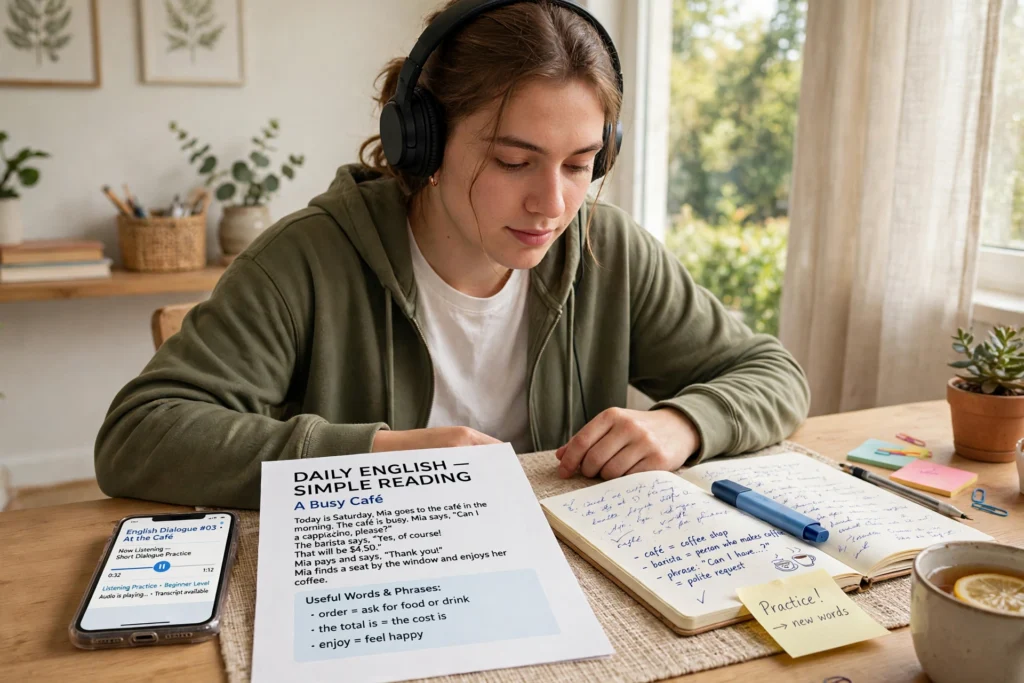
- Listening and reading support speaking, writing, and vocabulary. Start with a short paragraph on a topic you enjoy. Ask AI to explain hard words simply, read it aloud, then cover it and say the main idea in your own words. This retelling forces you to use the language, not just recognise it.
- For listening, ask AI to write a short dialogue in a shop, at work, or on the phone, and read both parts aloud.
- Reading also improves when you search well: the ideas in Google Search Tricks Most People Don’t Know can help you find simple articles, dialogues, and example sentences. Keep it short — one article or dialogue per session. Ten minutes every day helps more than two hours once a month.
A Simple 20-Minute Daily Plan
- Minutes 1 to 5: Speak. Chat with AI about your day. Say or type at least five sentences.
- Minutes 6 to 10: Write. Write three short sentences, ask for simple corrections, and rewrite one yourself.
- Minutes 11 to 15: Learn words. Minutes 16 to 20: Listen and retell. Review five words from yesterday, then learn three new ones with examples. Then read or listen to a short text and say its main idea in your own words.
If you have only ten minutes, do the first two parts. If you miss a day, do not do double the next day — restart with the normal 20 minutes. The note-taking ideas in AI for Students: Study Notes and Research the Smart Way pair well with this routine. Each week, look back: which words do you remember, and which activity did you enjoy most? Keep what works.

Mistakes to Avoid
- First, do not copy long AI answers without reading them. If you do not understand a sentence, ask for a simpler version.
- Second, do not practise only by reading answers — every session should include a moment when you produce English yourself.
- Third, do not trust every correction at once — some are style, not clear mistakes, so check surprising ones in a dictionary. Fourth, do not jump to very hard material too soon; stay with clear, simple English until short conversations feel comfortable. Finally, judge your own habit: did you practise today or use one new word? Small wins add up.
FAQ
Can AI really help me speak English better?
Yes, with regular practice: speak aloud, repeat corrections, and later use the same phrases with real people.
How much time should I practise each day?
About 15 to 20 minutes a day is a good start. Short, daily practice beats long, irregular sessions.
Should I let AI write my homework or messages?
Write your own short first version, then ask AI to check it. Copying a full AI text will not help you next time you write alone.
Do I need a paid AI tool?
No. Free AI chat tools are enough for conversations, corrections, and quizzes. Your habit matters more than the price.
Conclusion
Using AI to learn English faster is not about a magic shortcut. It is about making good practice easier every day: speak a little, write a few short sentences, learn useful words, and listen and retell in small steps. Use AI as a patient partner, but stay in charge — write first, check answers, and repeat corrections aloud.
Start today with the 20-minute plan, even if your first chat is only five simple sentences. Steady practice builds skill over time.